
Understanding Handgun Ammunition: 9mm, .45 ACP, and What’s Inside the Box
Explore the essentials of handgun ammunition, from FMJ to JHP, and learn what those numbers mean for your shooting experience.

Walk down an ammunition aisle and you’ll see a wall of abbreviations: FMJ, TMJ, JHP, and numbers like 115, 147, or 230. Those labels describe different things, and understanding them makes the shelf much less confusing.
This guide covers projectile construction, bullet weight, and why practice ammunition may differ from ammunition marketed for everyday carry. We’ll focus on 9mm Luger and .45 ACP without turning this into another caliber debate.
First, a Bullet Is Only Part of the Cartridge
People often call an entire round a “bullet,” but the bullet is the projectile that leaves the barrel. A complete centerfire cartridge has four main components:
- Bullet: The projectile.
- Case: The container holding the components together.
- Propellant: The material that produces gas when ignited.
- Primer: The component that initiates ignition.
When a box says 124-grain FMJ, it describes the bullet’s weight and construction. It does not describe the weight of the entire cartridge.
FMJ, TMJ, and JHP: What Do They Mean?
| Label | Full name | Basic construction | Common context |
|---|---|---|---|
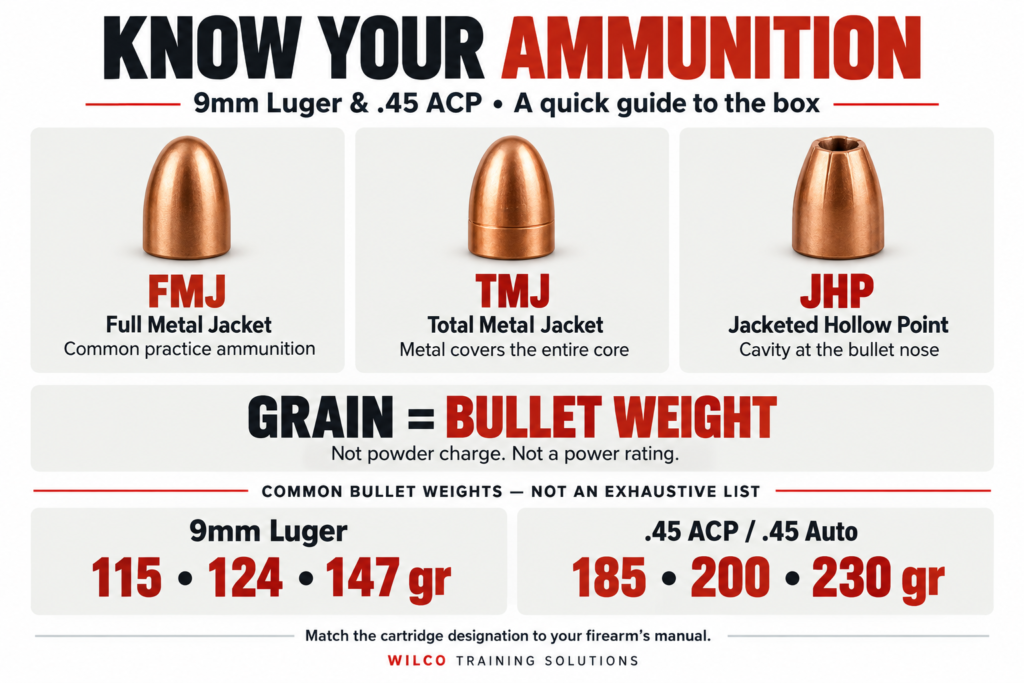
| FMJ | Full Metal Jacket | Metal jacket around the nose and sides; traditional designs often leave the lead base exposed | Target shooting and practice |
| TMJ | Total Metal Jacket | Metal covering encloses the entire lead core, including its base | Training, including some indoor-range ammunition |
| JHP | Jacketed Hollow Point | Jacketed projectile with a cavity in its nose | Many personal-protection loads; some target loads |
These labels describe construction, not a complete performance rating. The specific product still matters.
FMJ: A Familiar Practice Option
FMJ ammunition is widely used for target shooting because it is generally economical and available in many handgun chamberings. Its projectile is ordinarily designed without an expanding nose cavity.
“Full metal jacket” does not necessarily mean every surface is covered. Traditional FMJ construction often leaves exposed lead at the bullet’s base.
TMJ: Coverage Includes the Base
TMJ construction encloses the lead core completely. Speer explains that this prevents propellant gases from contacting exposed lead at the bullet’s base. Source: Speer Lawman
That distinction can matter at indoor ranges, but TMJ does not mean lead-free ammunition. Primers and other sources can still contribute to range contamination.
JHP: A Cavity in the Nose
JHP stands for jacketed hollow point. Many handgun JHP products are designed to expand under specified impact conditions, while some hollow-point designs serve target-shooting purposes.
The abbreviation alone does not guarantee expansion or establish suitability for a particular use. Read the manufacturer’s description for the exact product. Source: Federal Handgun Ammunition Basics
Why Use FMJ at the Range?
For routine practice, affordability matters. Spending less per round can make regular training easier to budget.
FMJ commonly fits that role because it offers:
- Lower cost: Typically less expensive than specialized personal-protection ammunition.
- Broad availability: Commonly offered in 9mm Luger and .45 ACP.
- Practical utility: Suitable for many ordinary paper-target sessions, subject to range rules.
FMJ is not the only training option. TMJ and other purpose-designed target loads may suit a facility’s requirements, and some ranges restrict particular projectile materials. Source: Federal Handgun Ammunition Basics
Check range rules before buying ammunition for a class. A familiar acronym is not a substitute for the facility’s ammunition policy.
Why Range Ammunition May Differ From EDC Ammunition
EDC means everyday carry. Range ammunition is commonly selected for affordable practice, while ammunition marketed for personal protection is designed around different performance requirements.
That helps explain why FMJ is common in training boxes and JHP is common in personal-protection product lines. It does not make either label a universal recommendation. Source: Federal Handgun Ammunition Basics
Two loads with the same caliber and bullet weight are not necessarily interchangeable in how they behave. Differences can include projectile shape, velocity, recoil feel, and where shots land relative to the sights.
Speer offers training ammunition intended to approximate the feel and point of impact of certain service loads, illustrating why matching involves more than the number on the box. Follow firearm-manufacturer guidance and seek qualified instruction rather than assuming every load behaves alike. Source: Speer Lawman
No projectile design removes the need for a safe backstop or awareness of what lies beyond the target.
What Does “Grain” Mean?
A grain, abbreviated gr, is a unit of weight. There are 7,000 grains in one pound.
On a factory ammunition box, the prominent grain figure normally identifies bullet weight. A 147-grain bullet weighs more than a 115-grain bullet.
It does not tell you:
- How much powder is inside the case.
- How much the complete cartridge weighs.
- Whether the ammunition is higher pressure.
- Whether the load is automatically more accurate or suitable.
Common 9mm and .45 ACP Bullet Weights
| Cartridge | Common bullet weights | How to interpret them |
|---|---|---|
| 9mm Luger | 115, 124, and 147 grains | Different projectile weights within the same cartridge designation |
| .45 ACP / .45 Auto | 185, 200, and 230 grains | Different projectile weights within the same cartridge designation |
These are common examples, not an exhaustive list. Manufacturer catalogs also contain other weights and specialized designs. Sources: Speer catalog, Federal catalog
Does a Heavier Bullet Mean More Recoil?
Bullet weight alone cannot answer that question. Velocity, propellant, firearm weight, and firearm design also matter.
Within a cartridge family, heavier bullets are often loaded to lower velocities, but that is a tendency rather than a universal rule. Compare the complete factory load instead of treating grain weight as a recoil rating. Sources: Federal load data, SAAMI technical information
Read the Box in Three Steps
| Example marking | What it tells you |
|---|---|
| 9mm Luger | Cartridge designation |
| 124 gr | Bullet weight |
| FMJ | Projectile construction |
Now compare .45 Auto · 230 gr · TMJ. The same three categories apply: cartridge, bullet weight, and construction.
These examples explain labels; they are not instructions to use a particular load. Other markings and product-specific restrictions still need attention.
Match the Ammunition to the Firearm
Use only ammunition designated by the firearm manufacturer. Check the firearm’s markings, its manual, and the ammunition’s original packaging.
A cartridge fitting into a chamber does not establish that it is safe to fire. Similar names also do not establish compatibility. Source: SAAMI ammunition interchangeability guidance
Remember Range Hygiene
Projectile construction is only one part of managing exposure at a shooting range. Ventilation, ammunition components, and cleaning practices also matter.
- Follow the facility’s hygiene rules.
- Keep food and drinks out of shooting areas.
- Wash hands, forearms, and face before eating or drinking.
- Wear appropriate hearing and eye protection.
TMJ ammunition does not replace these precautions. Source: CDC/NIOSH firing-range guidance
The Takeaway
Caliber identifies the cartridge, grain identifies bullet weight, and FMJ, TMJ, or JHP identifies projectile construction. Each answers a different question.
For 9mm and .45 ACP alike, understanding those labels helps you read manufacturer information, follow range requirements, and ask better questions before purchasing ammunition.
Frequently Asked Questions
What’s the difference between FMJ and JHP ammunition?
FMJ (Full Metal Jacket) ammunition has a soft core encased in a shell of harder metal, designed for feeding smoothly and penetrating targets. JHP (Jacketed Hollow Point) ammunition features a hollowed-out tip that expands upon impact, increasing stopping power and reducing the risk of over-penetration.
Why does the different grain weight in ammo matter?
Different grain weights in ammo affect velocity, recoil, accuracy, and terminal performance. Lighter grains typically offer higher velocity and less recoil, while heavier grains provide better energy transfer and accuracy at longer distances. Choosing the right grain weight depends on the intended use, such as target shooting or hunting.
Is there really a difference in handgun ammunition that uses 115grain vs 124grain?
Yes, there is a difference. The 115 grain ammunition typically offers higher velocity and lower recoil, making it suitable for competitive shooting. The 124 grain ammunition provides better stability and slightly improved accuracy at longer ranges, along with more energy, which can be beneficial for self-defense situations.
Why is FMJ ammo more tailored for range and training than JHP or TMJ?
FMJ ammo is typically less expensive to produce, has a less complicated design, and creates less barrel fouling, making it ideal for range and training. JHP is designed for expansion and stopping power, while TMJ offers reduced lead exposure but at a higher cost.
Make your next session count.
Explore training built around your team’s goals.