
What Is a Deadly Force Encounter? DFE Meaning, Stages, and Training Implications
A deadly force encounter (DFE) is an incident in which a person must use, or decide whether to use, force likely to cause death or serious bodily injury, typically against an armed or violent threat. In law enforcement and defensive training, “DFE” refers to the entire event: the moments before force is used, the fight itself, and the aftermath that follows.
That last part matters. Legal definitions describe the force. Officers live through the encounter. The two are related but not the same, and understanding the difference is the starting point for training that actually prepares someone for one.
What does “deadly force” mean legally?
Under federal policy language used by agencies like DHS and the Department of the Interior, deadly force is any force that carries a substantial risk of causing death or serious bodily injury. Intentionally discharging a firearm at a person is the obvious example, but strikes to the head or neck with an impact weapon and the use of edged weapons fall under the same definition.
Two Supreme Court cases frame when an officer can lawfully use it. Tennessee v. Garner (1985) ended the old common-law rule that any force could be used to stop a fleeing felon; deadly force now requires a significant threat of death or serious injury to the officer or others. Graham v. Connor (1989) established the “objective reasonableness” standard: an officer’s use of force is judged from the perspective of a reasonable officer on scene, with the information available at that moment, not with the benefit of hindsight.
Every officer learns those cases at the academy. What the academy spends far less time on is what the encounter itself does to the human being inside it.
Deadly force vs. deadly force encounter: why the distinction matters
Deadly force” is a legal category. A “deadly force encounter” is an event, and the event is bigger than the trigger press.
A DFE includes the recognition that a threat exists, the decision to act, the physical performance under extreme stress, and everything that comes after: the investigation, the legal review, and the psychological weight an officer carries home. Researchers like Dr. Alexis Artwohl and Lt. Col. Dave Grossman have documented each of those phases for decades, and their consistent finding is that the encounter reshapes perception, memory, and performance in ways most people never experience anywhere else.
This is why WILCO builds training around the DFE as a whole rather than marksmanship alone. A perfect score on a quiet range answers one question. It doesn’t answer whether an officer can make a lawful decision, perform under a crushed timeline, and function afterward. Those are three separate skills, and each one is trainable.
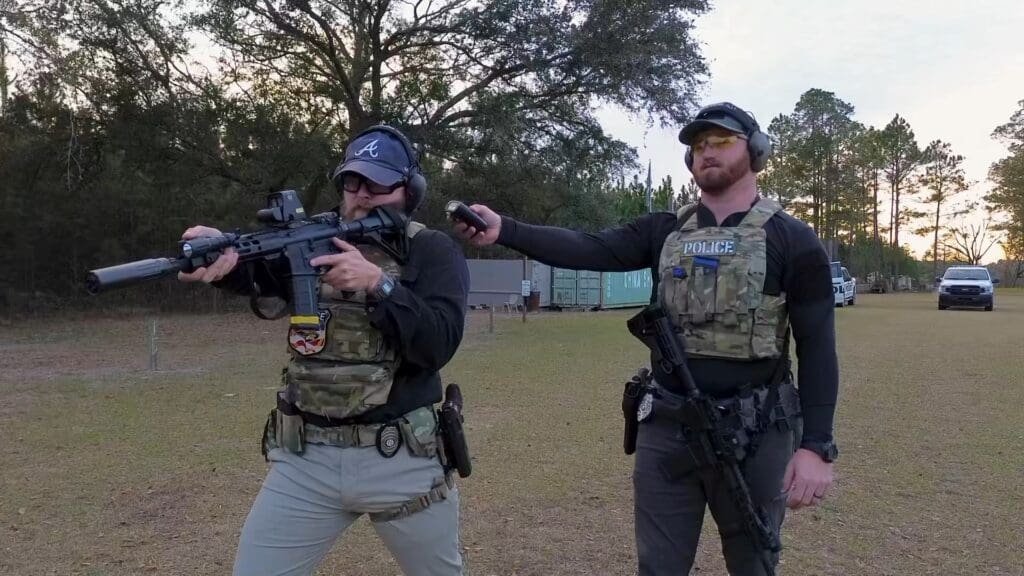
What are the stages of a deadly force encounter?
Before: recognition and decision
Most DFEs begin as something else: a traffic stop, a domestic call, an ordinary school day. The “before” stage is the compressed window where a person recognizes that the situation has changed and decides what to do about it. Two things determine how well that window gets used.
- The first is alertness, what defensive trainers call living in condition yellow: relaxed, but paying attention.
- The second is having a decision already rehearsed.
People under sudden threat don’t invent good responses on the spot; they default to whatever they’ve practiced. If they’ve practiced nothing, that’s what they default to.
During: the body takes over
Once the encounter turns kinetic, the sympathetic nervous system floods the body with adrenaline and stress hormones. Heart rate spikes. Blood moves to the large muscles. Fine motor control degrades. Perception itself changes: in Artwohl’s well-known survey of officers involved in shootings, 84% reported diminished sound, 79% reported tunnel vision, and 62% experienced the event in slow motion. Grossman’s On Combat documents the same territory: the body optimizes for gross physical survival at the direct expense of the precise skills a firearm demands.
The training implication is blunt. Skills that only exist at a conscious, deliberate level will not survive this state. Skills that have been repeated until they run without conscious thought will. WILCO’s benchmark of roughly 2,000 correct repetitions to build reliable muscle memory exists precisely because of this physiology, and it’s why our courses use shot timers and scenario pressure to let students feel a managed version of that stress before the real thing ever finds them.
After: the longest stage
The aftermath of a DFE routinely lasts longer than the encounter by orders of magnitude. There is an investigation, often administrative leave, legal review, and media attention. There is also the internal aftermath: sleep disruption, memory gaps, second-guessing, and effects on family. Artwohl and Christensen’s Deadly Force Encounters was written largely because officers reported the aftermath was harder on their careers and families than the gunfight itself.
Preparation helps here too. Officers who understand in advance what perceptual distortion and memory gaps are, and that they’re normal, navigate investigations and their own recovery better than officers blindsided by them. That’s why combat psychology is a pillar of every WILCO School Response Training course, not an afterthought, and why the aftermath and available resources get dedicated classroom time.
How fast does a deadly force encounter unfold?
Fast enough that there is no time to get ready; there is only the readiness someone brought with them. Officer-involved shootings are typically over in seconds and occur at close range, which compresses recognition, decision, and action into a nearly simultaneous demand. WILCO’s performance data supports a working benchmark: an experienced shooter can make the decision to use force, draw, and put accurate rounds on target in under two seconds. That number is the difference between a trained response and a hopeful one, and it’s the standard the SRT Course program is built to produce and measure.
What are the training implications of a DFE?
If a DFE is a whole event, training has to cover the whole event. In practice that means four things.
- First, repetitions of the fundamentals until weapon handling is automatic, because conscious thought will not be available.
- Second, stress inoculation: timed, scored, graded fire and scenario-based exercises that introduce consequences, so the first experience of performing under pressure doesn’t happen in a hallway.
- Third, decision training, because the legal standard judges the decision, not just the marksmanship. Force-on-force scenarios with pre-briefed variables build exactly this.
- Fourth, aftermath education, so officers know what’s coming after the worst day of their career and where to find support.
One more implication, and it’s the one most programs skip: measure everything. A district or agency should be able to see an officer’s readiness in numbers, not vibes. Every WILCO course logs times, scores, and diagnostics, and hands the full dataset to the officer and their supervisors at completion. If you’re evaluating your current program, our SRT (School Response Training) course covers where standard certification stops and measured proficiency begins.
If your officers’ training record can’t yet answer “are they ready for a DFE” with data, that’s a solvable problem. Visit our contact page or 803.371.4080 and we’ll map out what it takes.
Train Smart. Train Safe. Train WILCO.
Frequently Asked Questions
What does DFE stand for in law enforcement training?
DFE stands for Deadly Force Encounter: an incident in which a person must use, or decide whether to use, force likely to cause death or serious bodily injury against a threat. Training programs use the term to describe the full event, including the lead-up, the fight, and the aftermath.
Is a deadly force encounter the same as an officer-involved shooting?
Not exactly. An officer-involved shooting is one kind of DFE, but the term also covers incidents where deadly force was justified and prepared for but not ultimately used, and encounters involving weapons other than firearms.
When is deadly force legally justified?
In general, when a person reasonably believes a threat poses significant risk of death or serious bodily injury to themselves or others. For officers, Graham v. Connor requires the decision to be objectively reasonable based on what the officer knew at the moment. Specific standards vary by state and agency policy; this article is education, not legal advice.
What happens to the body during a deadly force encounter?
The sympathetic nervous system triggers a survival response: elevated heart rate, adrenaline release, loss of fine motor control, and perceptual distortions. Research by Dr. Alexis Artwohl found most officers in shootings experienced diminished sound, tunnel vision, or time distortion.