
8 Skills Every Officer Needs in Active Shooter Response Training for Schools
Table of Contents
You’ve completed the mandatory active shooter training. You sat through the slideshow, walked a school hallway with a blue gun, and earned your certificate.
That foundation matters. But the officers who perform best when the call comes in — when it’s real and it’s a school — are the ones who’ve trained beyond the minimum. Not because the basics are wrong, but because this environment demands more.
The gap between standard training and true readiness isn’t a reflection of effort. It’s a gap in how active shooter response training for officers has traditionally been designed and delivered — and it’s one that’s very much closeable.
Here are the 8 skills every officer needs in active shooter response training that separate prepared officers from documented ones — and the areas where focused training makes the biggest difference when it counts most.
1. Pistol Fundamentals That Hold Up Under Stress
Most departments qualify officers with a pistol twice a year — static targets, controlled environment, zero pressure. That’s a starting point, not an endpoint.
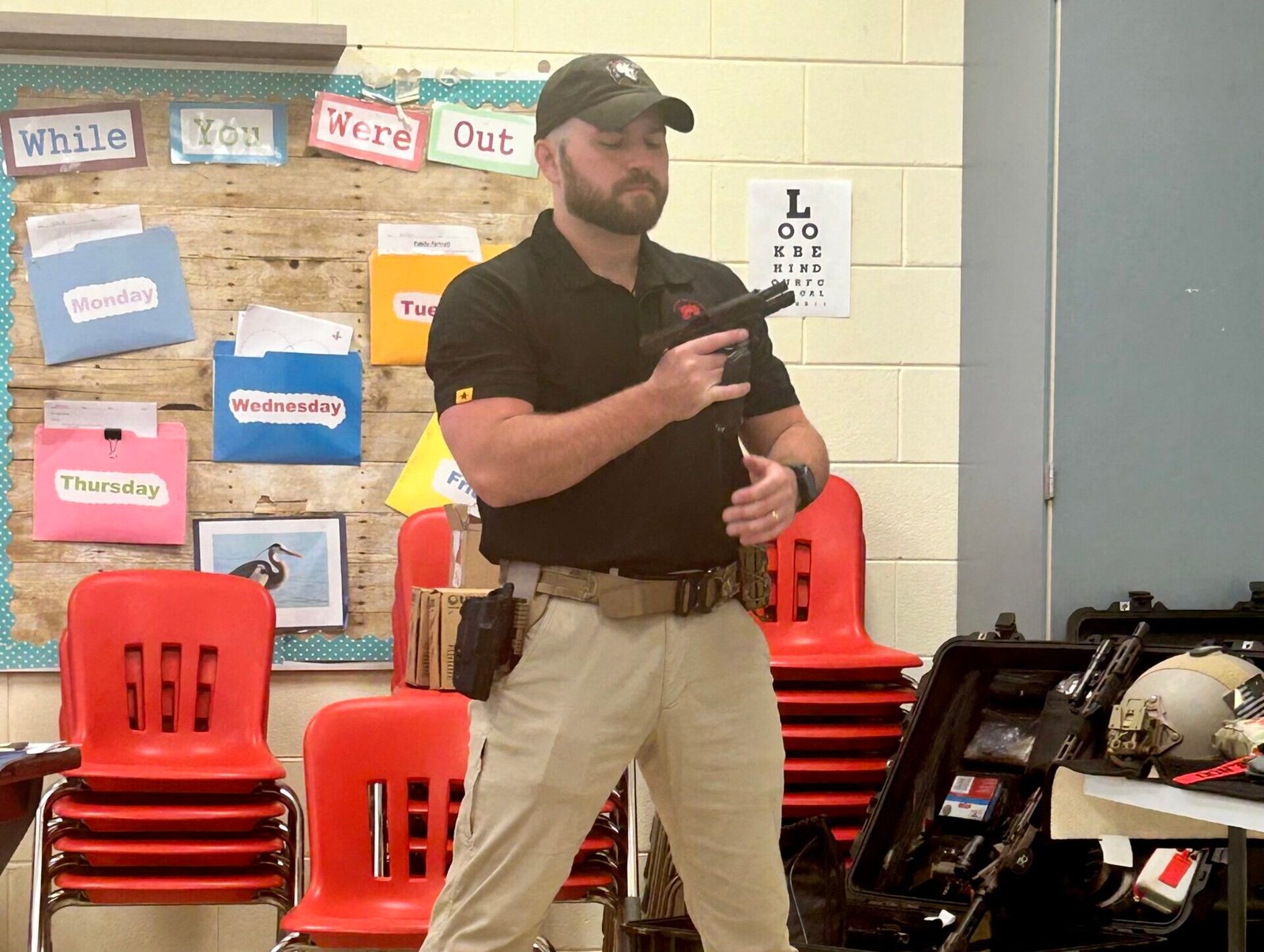
Effective active shooter response training for officers builds on that foundation by testing pistol skills the way a school response will actually demand them — moving, under elevated heart rate, making a shot-or-no-shot decision in under a second.
What that looks like in practice:
- Drawing from concealment or duty rig under time pressure
- Shooting while moving laterally and forward
- One-handed malfunction clearing
- Engaging targets at 3 to 25 yards with accuracy, not just volume
The goal isn’t to be uncomfortable for its own sake. It’s to ensure that when your nervous system is flooded with adrenaline, your hands already know what to do.
2. Patrol Rifle (Carbine) Manipulation — Not Just Accuracy
Range confidence with a patrol rifle is a solid start. But operating that same rifle through a school doorway, transitioning it in a crowded hallway, or running it with a compromised grip after sustaining an injury — those are different skills, and they require dedicated training.
School response training needs to address:
- Weapons transitions (rifle to pistol, smooth and fast)
- Operating effectively in confined spaces — not just open ranges
- Low-light and no-light target identification
- Reloads under pressure, including one-handed emergency reloads
The rifle is your most capable tool in a school environment. Comprehensive active shooter response training for officers ensures you own it completely before you need it most.
3. Threshold Evaluation — The Two Seconds That Shape Outcomes
Standard entry training often focuses on making the move — stacking on the door and committing. That’s not wrong, but it’s incomplete without threshold evaluation. Threshold evaluation is a disciplined, systematic scan of a room from the doorway before committing your body to the fatal funnel. Done correctly, it takes less than two seconds and gives you critical information: Where is the threat? Where are the victims? What’s the layout?
Skipping it — or never learning it in the first place — means moving blind into a space where every second of awareness matters.
Good active shooter response training for officers drills threshold evaluation until it’s automatic. It’s not glamorous. It’s the kind of disciplined habit that keeps you effective long enough to stop the threat and get everyone home.
4. Room Entry Techniques for Solo and Contact Team Response
Current doctrine — and the hard lessons of real-world events — affirm that immediate action saves lives. The first officer on scene at a school cannot always wait for backup. That means being trained and confident for solo entry, solo engagement, and solo decision-making. But when a second officer arrives, everything changes. Movement, communication, and roles shift immediately. Training needs to cover both realities.
School response training should address:
- Solo officer room entry — angles, movement, and threat prioritization
- Two-officer contact team dynamics — who leads, who covers
- Expanding to a three- or four-officer element
- Transitioning roles as officers arrive at different intervals
Well-rounded active shooter response training for officers covers all of these scenarios — with realistic repetitions under stress, not just one walk-through.
5. Deadly Force Decision-Making in High-Stakes Environments
Schools are among the most complex environments for use-of-force decisions. Threats are moving among potential victims. Students are running, hiding, and in some cases fighting back. There may be more than one armed person in the building.
The decisions officers face in these moments are genuinely hard — and they deserve genuine preparation. Training specifically designed for school environments develops the judgment needed to act accurately and decisively, not just quickly.
Your active shooter response training should include:
- Shoot/no-shoot scenarios set specifically in school environments
- Training that rewards sound decisions, not just accurate shots
- De-escalation options when the situation allows for them
- Clear policies on armed staff and school security personnel
This is the component of training most programs underinvest in. It also carries the highest real-world consequence — and the greatest opportunity for officers who train it seriously.
6. Communication Under Fire
Officers who train alone don’t develop the communication discipline that keeps a contact team coordinated, threat-aware, and moving effectively. Building communication into every drill — not just the debrief — is what creates officers who can operate as a cohesive unit under pressure.
That means practicing:
- Clear, short radio transmissions while moving
- Face-to-face coordination during entry
- Calling out threats, victims, and room-clear status
- Passing critical information to incoming units without breaking movement
If your active shooter response training runs silent except for the sound of gunfire, one of the most important skills in a multi-officer response is going underdeveloped.
7. Tactical Combat Casualty Care (TCCC/TECC)
The threat has been neutralized. Now an officer is down. A student is bleeding in the hallway. EMS is staged at the perimeter waiting for an all-clear. There is a window — often 5 to 10 minutes — between threat neutralization and medical arrival. Officers trained in casualty care can use that window to save lives. Officers who aren’t trained can only watch.
Core skills for this window include:
- Tourniquet application — on yourself and others
- Wound packing for penetrating trauma
- Airway management basics
- Understanding what to treat and what to hold for EMS
This isn’t a full paramedic course. It’s focused, practical preparation for the gap that often determines whether someone survives.
8. Post-Engagement Priorities and Mindset Reset
The immediate threat is down. What comes next is its own trained skill set. Officers who haven’t prepared for this moment can tunnel-vision on the downed threat, freeze on next steps, or miss a secondary threat entirely. Post-engagement training closes that gap.
Key skills include:
- 360-degree scanning for additional threats
- Clear radio communication — status, location, what you need
- Weapon retention in the immediate aftermath
- Transitioning mindset from threat engagement to scene security
The mental reset — shifting from stopping the threat to securing the environment and supporting your team — is a skill. It can be trained, practiced, and made reliable. Active shooter response training for officers that includes this phase produces professionals who can stay effective from first contact through full resolution.
Key Takeaways
- Active shooter response training for officers must be stress-inoculated — not classroom-only
- Solo and contact team tactics are distinct skill sets that each require dedicated reps
- Deadly force decision-making in school environments is its own discipline worth serious investment
- Communication, post-engagement priorities, and casualty care are as operationally critical as marksmanship
- The gap between mandated training minimums and genuine combat readiness is real — and it’s closeable
The Standard Worth Training To
There’s a meaningful difference between training that checks a box and training that builds the capability to perform on the worst day. School response training done right is demanding. It’s physical. It requires decision-making under pressure and the willingness to learn from every rep — in the training environment, where the cost of a mistake is a correction, not a consequence. That’s the standard. If your current active shooter response training is building toward it, keep going. If it isn’t, there’s never been a better time to find a program that does.
What is active shooter response training for officers?
Active shooter response training for officers is specialized tactical training designed to prepare law enforcement for deadly force encounters in real-world environments — including schools. It goes beyond standard department qualifications to build skills like stress-inoculated shooting, room entry techniques, contact team tactics, and post-engagement decision-making.
How is school response training different from standard active shooter training?
School environments present unique challenges — confined hallways, dozens of potential victims, complex use-of-force decisions, and the possibility of armed staff or multiple threats. School response training addresses those specific variables through scenario-based drills, shoot house exercises, and force-on-force repetitions that standard qualification courses don’t cover.
What skills should officers focus on for school shooting response?
The eight most critical skills are pistol fundamentals under stress, patrol rifle manipulation, threshold evaluation, solo and contact team room entry, deadly force decision-making, communication under fire, tactical combat casualty care (TCCC), and post-engagement priorities. Each requires dedicated repetitions in realistic conditions — not just classroom instruction.
Can a single officer respond effectively to an active shooter in a school?
Yes — and current doctrine supports it. Immediate action by a solo officer saves lives. Effective school response training prepares officers for solo entry, solo engagement, and solo decision-making, as well as the rapid transition to contact team tactics when additional officers arrive.
What is TCCC and why should school resource officers learn it?
Tactical Combat Casualty Care (TCCC) is a set of emergency medical skills designed for high-threat environments. For school resource officers, it covers tourniquet application, wound packing, and airway management — skills that can preserve life in the 5 to 10 minute window between threat neutralization and EMS arrival.
Who is WILCO’s School Response Training designed for?
WILCO’s SRT program is designed for school district police officers, school resource officers, school administrators, and other designated armed responders. The course is also available for pre-screened civilians and can be tailored to fit the specific needs of a school district or agency.