
Buying a Pistol (Part 3)
Discover essential advice on buying a pistol with insights from Wilco Training. Make an informed decision for your needs.

The post is finally here. The time has come for some random guy on the internet to tell you what kind of pistol you should buy. Unfortunately, that is not what is going to happen. This is not the way I do business. Using the three parts of this blog, hopefully we have begun to cultivate an objective way of thinking and at least highlighted a few things to consider. My goal is to pass on knowledge and facts (what little I have) so that others can form their own opinions created by the most up-to-date information. In this post we will cover pistol bore axis, the relation between bore axis and recoil management, and why this may be important to consider.
Define Your Priorities Before Choosing a Pistol
We want to survive a deadly force encounter (DFE) right? We want to stack the cards so high in our favor that when a DFE presents itself, it isn’t even fair. My old team leader used to say, “We want shootings, not gunfights” (We want justified shootings. We try to utilize every other method at our disposal to quell an issue and only use deadly force if all other alternatives have been exhausted and there is no other way). Once an issue escalates into a DFE however, the day is ours. In the simplest terms, how do I survive a DFE? I have to incapacitate the threat before they can incapacitate me. This means that I have to be faster and more accurate than they are. This concept also translates to: I need to put enough rounds quickly into the target until they drop. That means that I need to be able to manage the shit out of my recoil, track my sights, quickly regain sight picture/sight alignment, and master my trigger press.
*6 round bill drills, on paper bullseyes are a perfect skill-based training method to iron out everything I just mentioned*
Consider How Pistol Design Affects Recoil Control
Recoil control. That is what I am getting at with this post. We need a pistol. We can discuss training, ect. in later posts, but we are talking about hardware in this post. I want the pistol that I buy to work with me, not against me. I know that I need to win a deadly force encounter. I know that I have to put quick, accurate rounds into the threat until they drop. I know that I need excellent recoil control to accomplish this. I know that I want a pistol that doesn’t create unnecessary recoil. I know that I want a pistol with a low bore axis. Whoa, run that last one by me again?
What Is Pistol Bore Axis?
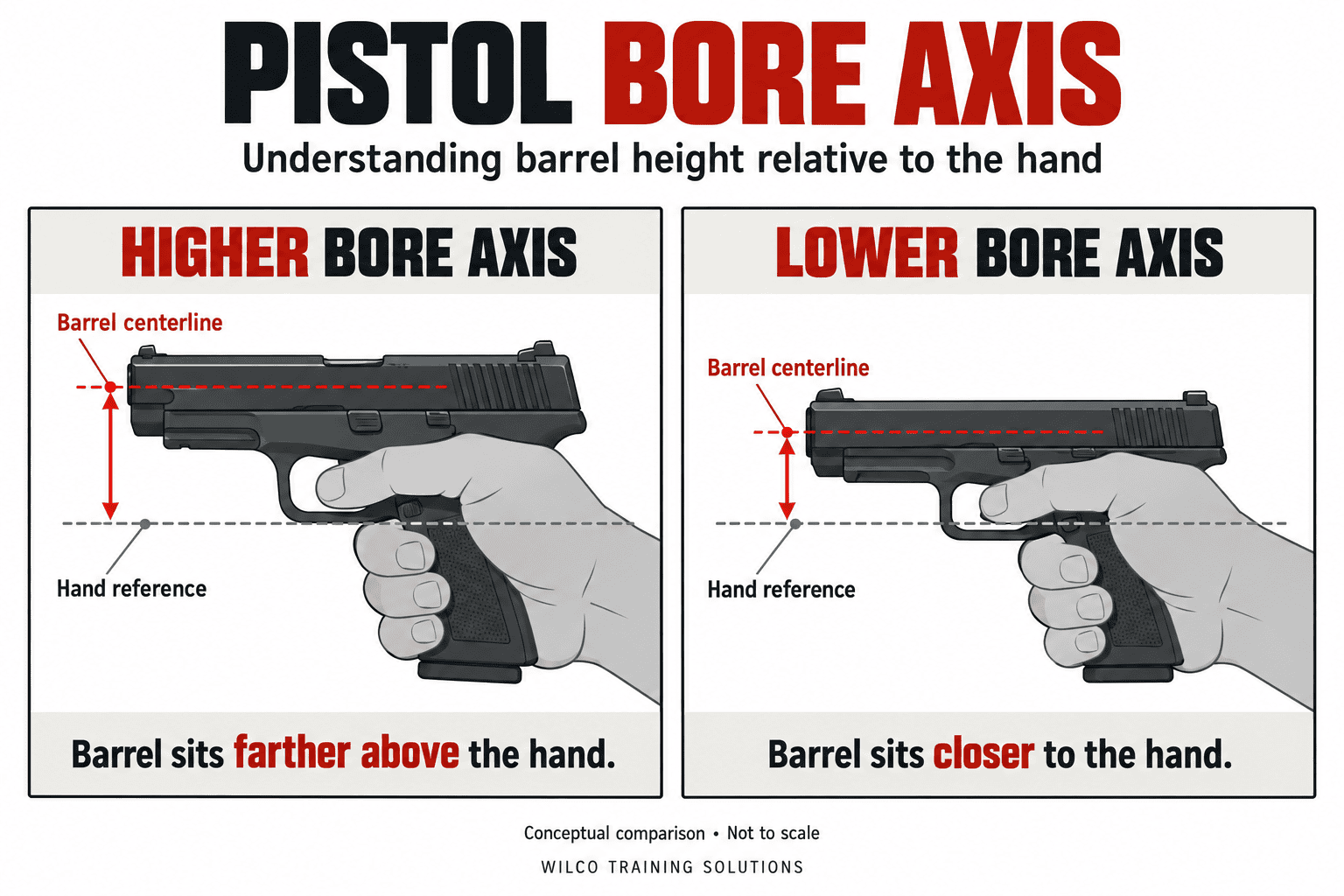
Comparing High and Low Bore Axis
The term bore axis refers to the relationship between the barrel of the firearm and the shooters hand. If a pistol has a high bore axis, the barrel is farther away from the shooters hand. Low bore axis means that the barrel is nearer to the shooters hand. Check the above image for excellent examples of low-high bore axis firearms. The lower the bore axis, the easier the recoil is to manage. If the recoil is easier to manage, then we can achieve follow-on shots more quickly and with better accuracy. If we can get quicker follow-on shots, we can eliminate the threat faster. Why is a high bore axis so terrible? Imagine a garden hose. The further away from the nozzle I grip, the less control I have over the hose. The same general concept applies to the pistol. Given a “thumbs forward” grip, the further the barrel from my hand, the more I have to work to compensate for the recoil. Again, I’m not saying it can’t be done. I am saying that, in a deadly force encounter when my life is on the line, I do not want to be fighting a threat and the recoil of my pistol.
Make an Informed Choice for Your Needs
In conclusion, let me be clear. I am not advocating for one firearm over another. For example, I am NOT saying you should buy a Glock and not buy a Sig. However, I strongly advocate forming your own opinions given the most correct and up-to-date information. We have discussed caliber, availability of parts and ammunition, the responsibility of carrying a firearm, and bore axis. Hopefully, now that the information has been disseminated, you can make a more informed decision on the perfect firearm to meet your unique needs.
Frequently Asked Questions
What is pistol bore axis?
Bore axis is the centerline running through the barrel. When comparing pistols, “high” or “low” bore axis generally describes how far that centerline sits above the shooter’s gripping hand.
What is the difference between a high and low bore axis?
A higher bore axis places the barrel farther above the hand. A lower bore axis places it closer to the hand. These descriptions compare relative geometry, rather than standardized categories.
Does a lower bore axis mean less recoil?
Not necessarily. Bore height influences the leverage that contributes to muzzle rise, but it does not determine total recoil by itself. Ammunition, firearm weight, operating system, and other design features also affect how recoil feels.
Does a higher bore axis make a pistol a poor choice?
No. A higher bore axis alone does not establish a pistol’s quality or suitability. Evaluate the firearm as a complete design rather than judging it by one measurement.
Make your next session count.
Explore training built around your team’s goals.